Mediator's craft
You Can't Win the Past
Two people can both be certain and both be wrong
- Memory is reconstruction
- Acknowledgment, not records
- Ask what's needed now
Picture the Monopoly Man. Does he have a monocle?
Most people picture one. He doesn’t. Never did. Same with the Berenstain Bears. Most people would spell it “Berenstein.” It’s “Berenstain,” and always has been. These are Mandela effects, named for the large numbers of people who distinctly remembered Nelson Mandela dying in prison in the 1980s. He didn’t. He was released in 1990 and lived another twenty three years.
What makes a Mandela effect interesting isn’t that people get it wrong. What’s interesting is that huge numbers of unrelated people get it wrong the same way. That’s memory as reconstruction, running the same pattern and landing on the same false answer, independently.
Rooms full of certainty
I bring this up because I sit in rooms full of people who are certain about the past, and the Mandela effect is easy proof that certainty isn’t evidence.
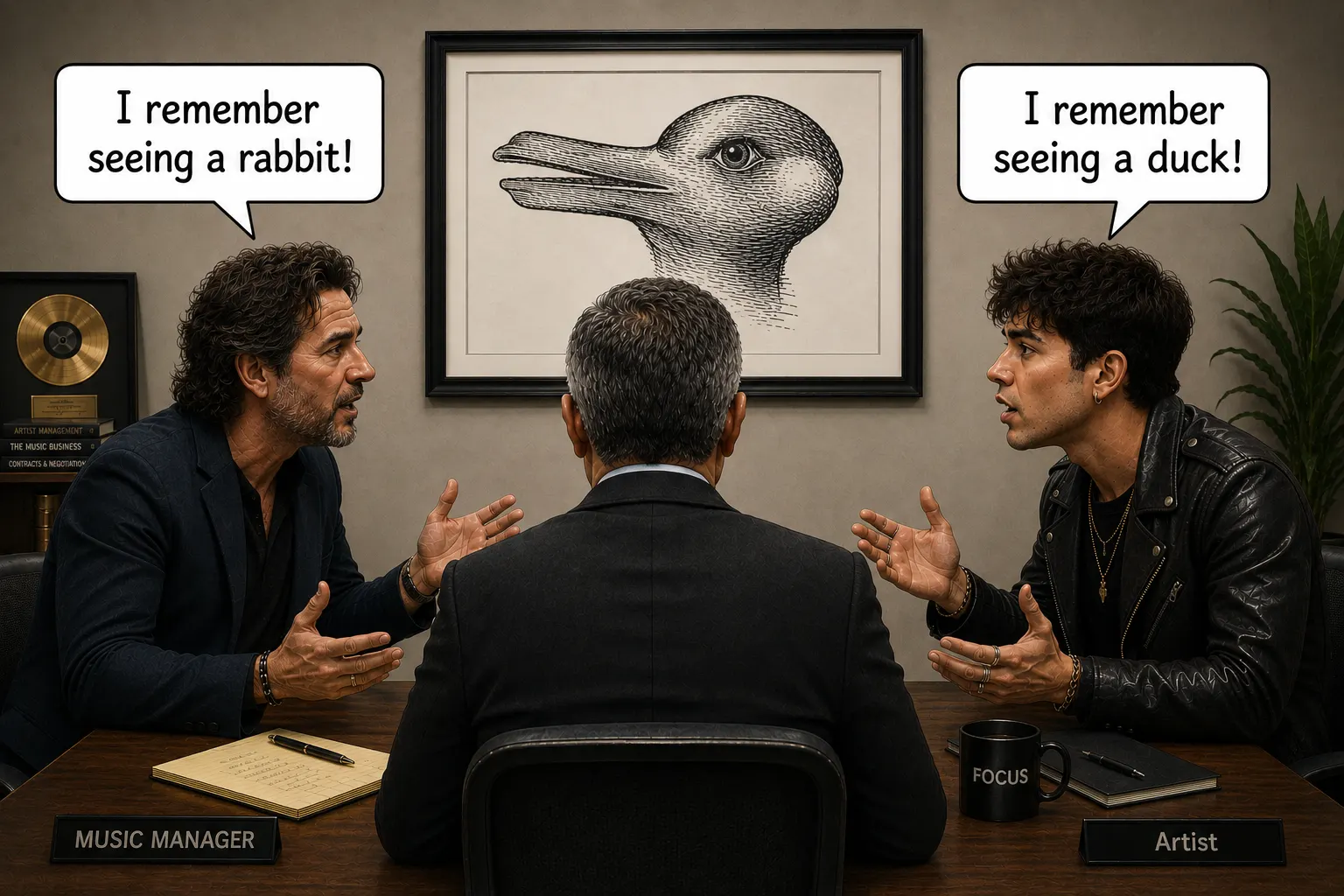
But it’s the wrong model for what actually happens in a dispute. A Mandela effect is convergent, different people, no contact with each other, arriving at the identical wrong memory. A dispute is divergent. Two people sat in the same room, heard the same conversation, and their memories didn’t converge on one version. They split. Each edited the memory to fit what they needed it to mean. Neither is lying. Both are certain, about two different things.
Reconstructive memory
Psychologists call this reconstructive memory. Imagine a website that dynamically rebuilds itself whenever you load in a page. That’s this exact situation. You’re not pulling up a file when you recall something, you’re rebuilding it, and the rebuild bends toward whatever you currently need to be true. Add the desire to have been right, or wronged, and the bending gets worse.
Nothing left to check
So when someone tells me they want the agreement to reflect what actually happened, what actually was said, I understand the ask. I don’t think it’s dishonest. I think it’s asking for something that no longer exists. There’s no tape, no neutral record to check either memory against. Just two subjective reconstructions, each bent in its own direction.
This is why you can’t win the past. Not because it doesn’t matter, it matters plenty. You can’t win it because winning would require someone to certify one memory as correct, and there’s nothing left to check it against. The past isn’t in the room. Two competing reconstructions of it are.
What they actually wanted
A goal of mediation is getting someone to see that. Because what they actually wanted was rarely a certified record. It was acknowledgment. Those aren’t the same thing, and one of them is available.
I ask them to state, in one sentence, what they want going forward, not what they want the document to say happened.
The agreements that hold up stop asking the past to confirm something and start asking what’s needed now or in the future. Not because the past stopped mattering. Because it stopped being winnable, and everyone in the room already knew that.